Why you blame yourself for other people’s mistakes

Why You Blame Yourself For Other People's Mistakes
Most people never call this one by its real name.
Self-blame.
Not the healthy kind, where you own your mistakes and take responsibility. That kind is good. That's just growing up.
I'm talking about the kind where somebody else makes a bad decision and your first thought is, "that was my fault."
The kind where your friend falls away and you think, "I should have said something sooner."
Or somebody hurts you, and your brain still finds a way to land it back on you: "I must have done something to cause this."
If that's you, this might be hard to hear.
That's not humility. That's pride turned inward.
I know that sounds backwards, because self-blame feels so humble. It feels like the opposite of arrogance. You're not walking around saying you're better than everyone. You're saying the opposite, that everything is your fault.
Underneath both of those is the same assumption.
That you were powerful enough to control the outcome.
Self-blame says, "I should have prevented this." That assumes you had the power to, and that's a God-sized expectation on human-sized shoulders.
Think about what's really going on when you blame yourself for someone else's decision.
"If I had been wiser, they wouldn't have done that." Hear what that actually says. You expected yourself to be wise enough to manage another grown person's choices.
"If I had loved them better, they wouldn't have left." That one expects your love to be strong enough to override somebody else's free will.
That's you expecting yourself to be God.
I lived this for years.
After I got saved, I carried guilt for everything. Not just my own sins. Everybody's.
If somebody I was mentoring fell back into addiction, I blamed myself, "I should have checked in more."
When a relationship in my circle fell apart, same thing, "I should have seen it coming."
Every time, I was digging for what I missed.
I thought that weight was proof that I cared. Really it was proof that I'd been clocking into a job that was never mine.
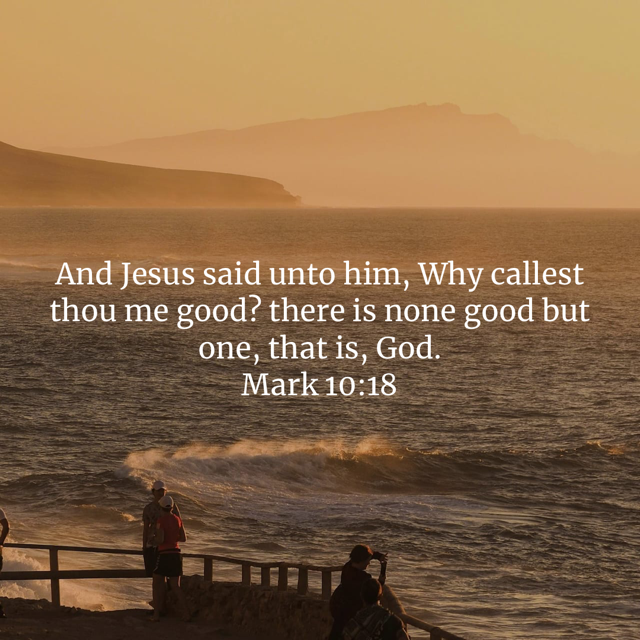
Here's what Jesus said, plain as it gets.
"There is none good but one, that is, God."
None good. Not the people who try really hard, and not the ones who take responsibility for everybody around them. Only God.
That means you were never the standard, and your perfection was never the thing holding everyone together.
Only God holds that role.
When you expect yourself to be good enough to prevent other people's failures, you've taken on a job God never gave you.
You are responsible for your obedience. You are not responsible for other people's decisions. Confusing the two will crush you.
I had to learn the difference between influence and control.
You can love someone and speak truth into their life.
You can model faithfulness in front of them day after day.
You can't control what they do with any of it.
That's their free will, and God Himself honors it. He doesn't force anybody to choose Him. He invites and He draws, but He never overrides a person's choice.
If God, with all His power and all His goodness, lets people make bad decisions without blaming Himself for them, why are you carrying that weight?
"So then every one of us shall give account of himself to God."
Romans 14:12 (KJV)
Every one of us gives account of himself. Not for the people around him, not for the choices his kids made or his spouse made. God made accountability personal. Your account is yours. Theirs belongs to them.
Carrying theirs on top of yours doesn't make you noble. It just crushes you under a weight God never handed you in the first place.
Here's where the gospel comes in.
Deep down, you believe your goodness is what holds everything together. If you're good enough, things hold. If you slip, it all falls apart.
That's works-based thinking, just pointed at your relationships instead of your salvation. It's the same lie telling you your effort is what makes everything work.
The gospel says the opposite.
You were never good enough to hold it all together. That was always God's job. Trying to do His job is what's breaking you.
Self-blame is what happens when you try to be the savior of every situation you walk into. That job was filled a long time ago, and it was never yours.
When I finally put in my notice, something shifted.
I could love people without getting wrecked every time they made a bad choice.
I could mentor somebody without carrying their relapse around like it was my failure.
I didn't stop caring. I just stopped confusing my role with God's.
My job is to be faithful and love people well, and I let God handle the outcomes and the heart-changing. I stopped crossing that line.
Quitting that job doesn't make you careless. What it actually does is free you up to love people without the pressure of being perfect, and to serve without hauling everybody else's choices on your back.
The gospel says only one Person was ever good enough to hold it all together. It wasn't you. It was Jesus.
I hope you can rest in that today.
Here's how you start setting that weight down today.
1. The next time you catch yourself saying "this was my fault" about someone else's decision, pause.
Ask yourself one honest question. Was this actually mine to carry, or am I picking up a weight God never handed me? There's a difference between owning your mistakes and absorbing everybody else's.
2. Quit saying, "If I had been better, they wouldn't have done that."
You're responsible for your faithfulness, not their choices. Their decisions belong to them and to God. Release what was never yours to carry.
3. If self-blame has been your pattern, trace it back to the root.
You're not just being hard on yourself. You're expecting yourself to be God, and that expectation will never give you peace, only exhaustion. Quit the job and let God be God. You were never hired for it, and you don't have to keep clocking in.
PRAYER
Heavenly Father, I've been carrying blame that was never mine.
I expected myself to be good enough to stop other people's pain and other people's bad choices.
When I couldn't, I turned around and punished myself for it.
But You said it plain. There is none good but God.
That means I was never supposed to hold this weight in the first place.
Today I step down.
I'm letting go of outcomes I was never assigned to manage.
I'm faithful, but I'm not God, and I'm done pretending I should be.
Free me from the pride that keeps dressing up as humility.
Remind me that the only One who holds it all together perfectly is Your Son, not me.
In Jesus' precious name we pray. Amen.